A plasmid or circular genome
You have a plasmid, or another sequence with no ends, and its annotation as GFF3, as an annotation tool such as Bakta or Prokka writes it.
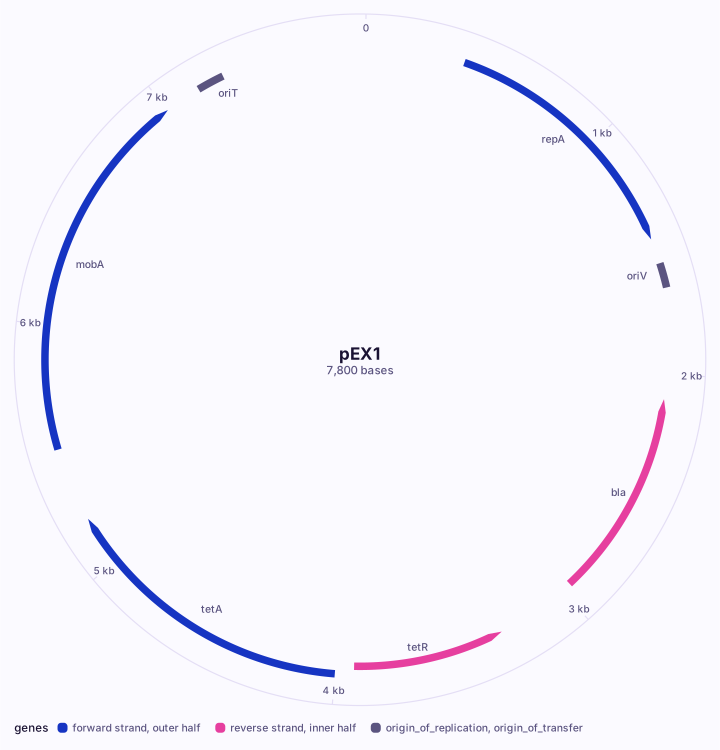
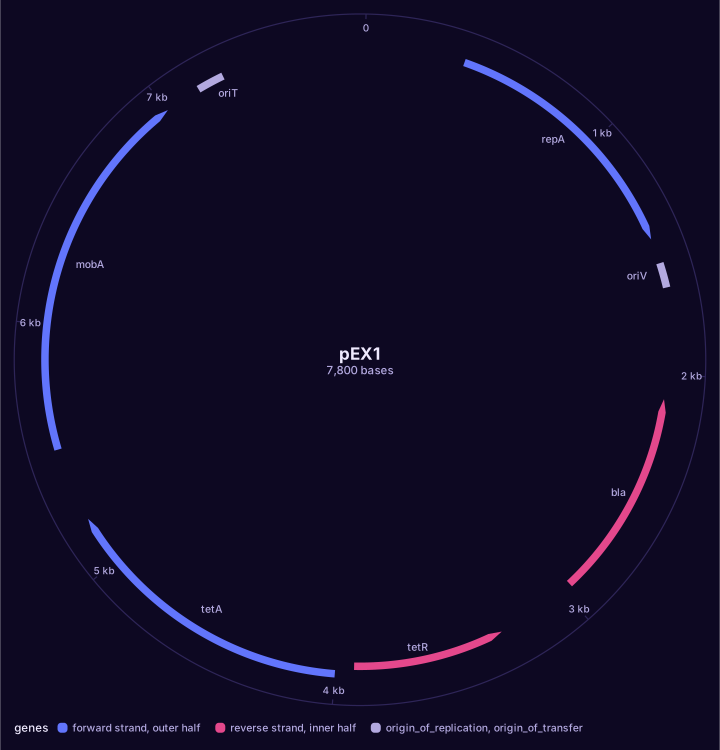
The place is the sequence, by its name, and --circular draws it round:
position zero at twelve o'clock, running clockwise, inside a ruler. A circle
closes where its sequence ends, which the annotation's ##sequence-region
line says here; a FASTA of the sequence among the files says it too. Each gene
is an arc ending in a point at its 3' end, on the outer half of the ring for
the forward strand and the inner half for the reverse, so the divergent pair
tetR and tetA point away from each other. What the annotation calls something
other than a gene, here the origins of replication and of transfer, is an arc
with no point in a muted ink, keyed by what the annotation calls it. The ring
is named for what it holds, and the key under the circle says what each colour
means.
Change it
| To | Write |
|---|---|
| Add the sequence's GC skew as a second ring, which turns over at the origin of replication | pEX1.fa after pEX1.gff3 |
| One colour for every gene | pEX1.gff3 --color '#6a3d9a' |
| Name the ring yourself | pEX1.gff3 --label annotation |
| Leave the names off | pEX1.gff3 --no-names |
| Leave out the key | --no-legend |
| Another title in the middle | --title 'pEX1, a plasmid' |
| Draw it along a line, the genes as arrows | leave out --circular |
| Draw one stretch of it along a line | pEX1:3,000-5,500 pEX1.gff3, with no --circular |
Calls and depth over the plasmid are rings of their own in the same way, in the order written, the first outermost; a whole sequence draws a chromosome round with both.
The example files: pEX1.gff3 and
pEX1.fa. Every option: karyon help features, or the
command line reference.