Coordinates
karyon counts every position one way: 0-based and half-open, as BED does. This page gives that rule, the two places that count from one instead, and what each file format's numbers turn into on the way in.
In short
| You have | In karyon it is |
|---|---|
| a BED, bedGraph, cytoBand or PAF start and end | both as they are |
| a GFF3 start and end | start - 1, and the end as it is |
a VCF, SAM or samtools depth position |
pos - 1 |
a locus string such as chr1:101-200 |
Region::parse("chr1:101-200"), which converts it |
| a codon number, such as the 450 of S450L | CodonTrack::span_of(450), which counts from 1, and from the highest coordinate on the reverse strand |
The readers in karyon::read make these conversions for you, and the command
line reads its files with them. You make a conversion yourself only when you
build a Feature, a Variant or another value by hand.
One convention
use karyon::Region;

let region = Region::new("chr1", 100, 200)?; // bases 100 to 199
assert_eq!(region.len(), 100);               // end - start, with no + 1
assert!(region.contains(199));               // the last base
assert!(!region.contains(200));              // the end is not in the region
The first base of a sequence is 0, and end is one past the last base
included. Two useful things follow. The length of an interval is end - start,
with no correction anywhere. And two intervals touch exactly when one's end
equals the other's start, so a gap of no bases is written as zero rather than
as minus one.
Every constructor that takes a position counts this way unless its
documentation says otherwise: Region::new, Feature::new, Variant::new,
Window::new, Read::new, Band::new, Association::new, MethylSite::new,
Junction::new, StructuralVariant::new, CladeBlock::new,
SplitSegment::new, DomainFeature::new, CodonTrack::new, and the _at
forms on the plot() builder, such as add_coverage_at and add_sequence_at.
Why one convention matters
An off-by-one in a genomic figure does not crash anything. The figure still draws, the tracks still line up with each other, and the only thing wrong with it is that every mark sits one base from where the data put it. That is why the conversion happens in as few places as possible, and why the test suite pushes a known base through every reader and checks where it lands.
The two exceptions
The 1-based, inclusive counting of samtools, IGV, GFF3 and VCF appears in two places, and in both a person reads the number rather than a program.
The locus string. Region::parse takes the string you would paste into a
genome browser, and to_string() prints it back the same way. The region you
give the command line is the same string.
let region = Region::parse("chr1:101-200")?;    // what you type into IGV
assert_eq!(region.start(), 100);                // 0-based
assert_eq!(region.end(), 200);                  // exclusive
assert_eq!(region.len(), 100);
assert_eq!(region.to_string(), "chr1:101-200");
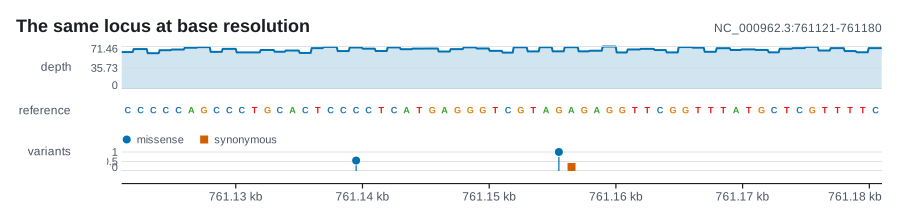
The numbers printed on a figure. The tick labels of AxisTrack, the codon
numbers of CodonTrack, the locus in the top right corner and the positions in
tooltips all count from one, so any of them can go straight into a browser's
search box. AxisTrack picks its ticks in 1-based space, so that the labels
come out round, and draws each one at scale.x(pos - 1).
Converting by hand
A VCF POS or a GFF3 start is pos - 1 on the way in. A GFF3 end goes
in unchanged: a 1-based inclusive end is already one past the last base
once counting starts at zero. A BED start and end both go in as they
are.
use karyon::{Feature, Variant};

// A VCF line at POS 761,155.
let call = Variant::new(761_155 - 1);
assert_eq!(call.pos, 761_154);

// A GFF3 record from 759,807 to 763,325, 1-based and inclusive.
let gene = Feature::new(759_807 - 1, 763_325);
assert_eq!((gene.start, gene.end), (759_806, 763_325));
assert_eq!(gene.len(), 3_519);

// The same gene as a BED line, 759806 763325, goes in unchanged.
assert_eq!(Feature::new(759_806, 763_325), gene);
The Region API
A Region is a sequence name and a half-open interval on it. It is all a
Figure needs to know about what it draws: the one Scale that every track is
mapped through is built from it.
| Method | Returns | Counts |
|---|---|---|
Region::new(seq, start, end) |
Result<Region, Error> |
0-based, half-open |
Region::parse(locus) |
Result<Region, Error> |
1-based, inclusive |
seq() |
&str |
|
start() |
u64 |
0-based, the first base included |
end() |
u64 |
exclusive, one past the last base |
len() |
u64 |
end - start, always at least 1 |
contains(pos) |
bool |
0-based, and false at end |
display_start() |
u64 |
1-based, start + 1 |
display_end() |
u64 |
1-based inclusive, equal to end |
to_string() |
String |
seq:display_start-display_end |
let region = Region::parse("chr1:101-200")?;
assert_eq!(region.display_start(), 101);            // what a reader is shown
assert_eq!(region.display_end(), 200);
assert_eq!(Region::new("chr1", 100, 200)?, region); // the same window, 0-based
parse forgives what a locus string picks up in transit and refuses anything
that would change the answer. Thousands separators (, and _) and spaces
inside the numbers are ignored, and the string is split at its last colon,
so a sequence name that contains colons survives. to_string() writes the
numbers without separators, and what it writes parses back to the same region.
let region = Region::parse("NC_000962.3:761,100-761,200")?;
assert_eq!(region, Region::new("NC_000962.3", 761_099, 761_200)?);
assert_eq!(region.to_string(), "NC_000962.3:761100-761200");
assert_eq!(Region::parse("gi|123|ref|NC_1.1:5-8")?.seq(), "gi|123|ref|NC_1.1");
Anything else is an error rather than a guess:
assert!(Region::parse("chr1:0-200").is_err());   // 1-based coordinates start at 1
assert!(Region::parse("chr1:200-100").is_err()); // end is before start
assert!(Region::parse("chr1:100").is_err());     // expected start-end after the colon
assert!(Region::new("chr1", 100, 100).is_err()); // a figure needs at least one base
The first three are Error::InvalidLocus, which carries the string and the
reason, and the last is Error::EmptyRegion. Both convert into
std::io::Error, so parsing a region and writing its figure to a file can
share one ?.
A base is a span, not a point
use karyon::{Region, Scale};

let scale = Scale::new(&Region::new("chr1", 100, 200)?, 50.0, 500.0);
assert_eq!(scale.x(100), 50.0);        // left edge of the first base
assert_eq!(scale.x_center(100), 52.5); // and its middle
assert_eq!(scale.x(200), 550.0);       // the end of the region is the right edge
Scale maps a 0-based position to an x in the image. The base at position p
covers the pixels from x(p) to x(p + 1), so Scale::x gives the left edge
of a base and Scale::x_center gives its middle. Which of the two a track uses
is a real choice:
| Mark | Drawn at | Because |
|---|---|---|
| a variant | x_center(pos) |
a call is an event at one base |
| a feature | from x(start) to x(end) |
it is an interval, and its half-open end lands on the edge of the next base |
| a ruler tick | the left edge of the base it numbers | a ruler marks boundaries |
AxisTrack::center_on_bases(true) moves the ticks to the middle of the bases
they number. That suits a sequence logo or a short motif, where a base is a
column you can see rather than a fraction of a pixel.
What a file's numbers become
karyon::read is the one place where the convention is not uniform, because
each file format defines its own. Every reader says which one it reads and has
a test that pins a known base through the conversion, and a property test
checks that nine of the formats put the same interval on the same bases,
wherever it starts. What each format should look like is on
File formats.
| Format | Flags | The file counts | On the way in |
|---|---|---|---|
| BED | --features, --loci |
0-based, half-open | unchanged |
| bedGraph | --coverage, --windows, --dynseq |
0-based, half-open | unchanged |
| cytoBand | --ideogram |
0-based, half-open | unchanged |
| bedMethyl, from modkit | --methylation |
0-based | unchanged |
CNVkit .cns |
--copy-number |
0-based, half-open | unchanged |
| PAF | --synteny, --dotplot |
0-based, half-open, on both sequences | unchanged |
| GFF3 | --features, --loci, --clades |
1-based, inclusive | start - 1, end unchanged |
ASCAT segments, .seg |
--copy-number |
1-based, inclusive | start - 1, end unchanged |
STAR SJ.out.tab |
--junctions |
1-based, inclusive, on the intron | start - 1, end unchanged |
| InterProScan TSV | --domains |
1-based, inclusive, in residues | start - 1, stop unchanged |
| VCF | --variants |
1-based | POS - 1 |
| SAM | --pileup, --split-reads |
1-based | POS - 1, and the same for each pos in an SA tag; the end is walked from the CIGAR |
samtools depth |
--coverage |
1-based | pos - 1 |
| Bismark methylation extractor | --bisulfite |
1-based | pos - 1 |
| a table of positions and values | --manhattan |
1-based | pos - 1 |
| positions along a table's header row | --matrix |
1-based | pos - 1 |
| VCF of structural calls | --structural |
POS is the base before the event |
POS and END unchanged |
| a bare column of values | --coverage |
no coordinates | the first value is the first base of the region |
| FASTA | --sequence, --orfs, --with-sequence |
no coordinates | byte n of the record is the base at 0-based n, cut down to the region |
| aligned FASTA | --msa, --snps, --logo |
no coordinates | the alignment column, counted from 0, is the position |
| Newick | --tree, --tanglegram |
no coordinates | none: a phylogeny is not drawn on the axis |
Two rows need a second look. A structural call is the exception among the
1-based formats: a symbolic allele such as <DEL> cannot be written without a
reference base, so POS is the base before the event, which is already the
0-based start, and END is already the half-open end. Taking one off POS, as
for an ordinary VCF, would move every call a base to the left. And
--sequence, --orfs and --with-sequence take the only record of a FASTA
file whatever its name, or the one named like the region when the file holds
several.
Three more things follow from how the readers filter:
- A whole-genome file is fine to hand over. Rows naming another sequence are skipped, and rows outside the region are dropped rather than carried into a track that would not draw them. A bedGraph interval is clipped to the region, so a genome-wide file is never widened into memory one base at a time. A cytoBand table is the exception: all the bands of the named sequence are kept, because an ideogram draws the whole of it.
- Overlap counts, containment does not. An interval is kept when
end > region.start()andstart < region.end(). A gene that runs off both edges of the window is drawn running off both edges, which is what rpoB does in most figures of its locus. - A deletion belongs to the window even when its anchor does not. VCF
writes a deletion one base to the left of the bases it removes, so the reader
tests the span that
REFspells rather than the anchor alone. APOSone base before the window with a five-baseREFis still a call about the window.
The same gene, as BED and as GFF3, comes out as the same pair of numbers:
use karyon::{read, Region};
let region = Region::parse("NC_000962.3:759,000-764,000")?;
let bed = "NC_000962.3\t759806\t763325\trpoB\t0\t+\n";
let gff3 = "NC_000962.3\tRefSeq\tgene\t759807\t763325\t.\t+\t.\tName=rpoB\n";
let vcf = "NC_000962.3\t761155\t.\tC\tT\t900\tPASS\tAF=0.98\n";
let from_bed = read::interval::features(bed, ®ion, None)?;
let from_gff3 = read::interval::features(gff3, ®ion, None)?;
assert_eq!(from_bed, from_gff3); // one gene, whichever file it came from
assert_eq!(read::point::variants(vcf, ®ion)?[0].pos, 761_154);
The region is a coordinate system
A region's name is never looked up: nothing checks that the sequence exists or how long it is. The readers use the name to pick their rows out of a file, and the figure prints it in its corner. Beyond that, the axis counts whatever the data counts, and several tracks put something other than bases on it. The region is then written in that unit.
| Track | The axis counts | A region for it |
|---|---|---|
MsaTrack |
alignment columns, gaps included | Region::new("alignment", 0, 900) for 900 columns |
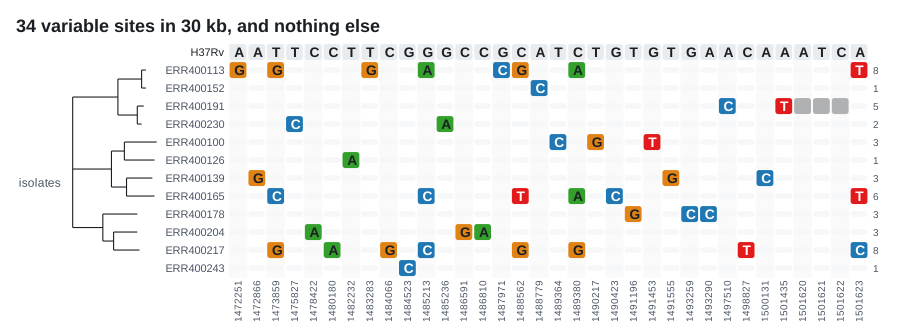
SnpTrack |
variable sites, evenly spaced | Region::new("sites", 0, 20) for 20 sites |
SquiggleTrack |
samples of the raw signal, which is time | Region::new("read", 0, samples) |
DomainTrack |
residues of a protein | Region::parse("P00533:1-1210") |
- An alignment is not ungapped for you. Mapping a row back to reference coordinates is a real operation with real decisions in it, and karyon does not make them behind your back. The ruler under an alignment counts columns.
- A variable-site panel is not linear in the genome. It drops the columns
that agree and spaces the rest evenly, so two neighbouring columns may be
nine bases or nine kilobases apart. Each column prints its own position
underneath instead, counted from one like the ruler's, and an
AxisTrackdoes not belong under the panel:SnpTrackanswersfalsetoTrack::on_coordinates, so a plot of the panel alone gets no ruler.SnpTrack::from_alignmentnumbers alignment columns from 0, so the first column is labelled 1. Move every position together withSnpTrack::offset, or build theSnpSitevalues yourself, 0-based like every other position. - An ideogram shows where the region is, not what is in it.
IdeogramTrackdraws the whole sequence across the plot and marks the part in view, so its x is not the ruler's, and it answersfalsetoTrack::on_coordinatestoo. - A phylogeny is not on the axis at all. A tree's x is a branch length or a
depth, so
TreeTrackandTanglegramTrackanswerfalsetoTrack::on_coordinates, and a plot holding nothing but trees gets no ruler. - A comparison measures only its first sequence. The region is on the
query of
SyntenyTrackandDotplotTrack; the target is measured against the height of the dot plot or the width of the lower bar.
Several sequences on one axis
Genome goes the other way: it lays several sequences end to end and hands
back the one region that covers them, so every track works across all of them
at once.
use karyon::Genome;

let genome = Genome::new([("chr1", 1_000_000u64), ("chr2", 600_000)]);
let at = genome.at("chr2", 1_000).unwrap();
assert_eq!(at, 1_001_000);
assert_eq!(genome.locate(at), Some(("chr2", 1_000)));
assert_eq!(genome.region().seq(), "genome");
The cost is that the axis is a concatenation, so a distance across a join is
not a distance. GenomeTrack draws
where the joins are and names each sequence, because a ruler of global
coordinates would be a ruler of a coordinate system nothing else uses.
Genome::at answers None for a name the genome does not have and for a
position past the end of its sequence, which is what a file called against
another reference, or 1-based positions handed in unconverted, look like. Names
are matched exactly: chr1 and 1 never meet.
Codons, a third numbering

A change in a coding sequence is named by residue: BRAF V600E, TP53 R175H, rpoB
S450L. CodonTrack is the ruler that
can be pointed at with those names. It takes the coding sequence as a 0-based
half-open span, like everything else, and numbers the codons from 1, like
every protein coordinate. A GFF3 or GenBank CDS therefore goes in as
start - 1, with its end unchanged.
use karyon::{CodonTrack, Strand};

// rpoB, forward strand, 0-based half-open.
let ruler = CodonTrack::new(759_806, 763_325, Strand::Forward);
assert_eq!(ruler.codons(), 1_173);
assert_eq!(ruler.codon_of(761_154), Some(450));
assert_eq!(ruler.span_of(450), Some((761_153, 761_156)));
On the reverse strand codon 1 sits at the highest coordinate and the
numbering runs right to left. span_of still reports a span low coordinate
first, on both strands, so it can go straight to a Scale.
let ruler = CodonTrack::new(1_000, 1_030, Strand::Reverse);
assert_eq!(ruler.span_of(1), Some((1_027, 1_030)));  // codon 1 at the top
assert_eq!(ruler.span_of(10), Some((1_000, 1_003))); // the last at the bottom
assert_eq!(ruler.codon_of(1_029), Some(1));
assert_eq!(ruler.codon_of(1_000), Some(10));
Hand in the reference as it is, never its reverse complement. On the reverse strand the track complements the bases and reads them backwards itself.
// The reference reads TTACCACAT. Complemented and read backwards that is
// ATGTGGTAA: methionine, tryptophan, stop.
let cds = CodonTrack::new(0, 9, Strand::Reverse).sequence(0, b"TTACCACAT".to_vec());
assert_eq!(cds.residue_of(1), Some(b'M'));
assert_eq!(cds.residue_of(2), Some(b'W'));
assert_eq!(cds.residue_of(3), Some(b'*'));
residue_of answers Some(b'*') for a stop, and None when no sequence is
attached, when the slice does not reach that codon, or when one of its bases is
ambiguous. A codon with no letter is drawn without one rather than guessed at.
Why a track, and not a division by three
The partition is itself the claim. Two changes at different bases of one codon are competing alleles at one residue rather than a double mutant, and two changes in neighbouring codons are two substitutions however few bases apart they are. Neither statement can be made on a ruler of bases.
Roughly half the coding sequences in any annotation run backwards, and
numbering one of them from the wrong end is silent: the figure still draws
and merely names the wrong residue. The chevron the track draws on codon 1
(CodonTrack::show_start, on by default) is the one thing on a
reverse-strand ruler that says where the count starts at a glance.
A coding sequence whose length is not a multiple of three
The partial codon left over is not counted and not drawn, since a third of a residue is not a residue. It sits at the end the count finishes on, which depends on the strand:
let forward = CodonTrack::new(0, 11, Strand::Forward);
assert_eq!(forward.codons(), 3);
assert_eq!(forward.codon_of(9), None); // the leftover is at the high end

let reverse = CodonTrack::new(0, 11, Strand::Reverse);
assert_eq!(reverse.codon_of(10), Some(1));
assert_eq!(reverse.codon_of(1), None); // and here at the low end
A genetic code that reassigns a residue
Translation uses NCBI table 1. Table 11, which bacteria, archaea and plastids use, differs from it only in which codons may start a protein, so the residues are identical. A table that reassigns a residue has to be passed in, because translating with the wrong one gives a plausible protein that is wrong.
genetic_code takes the sixty-four residues in NCBI order, TTT, TTC,
TTA, TTG, TCT and on to GGG, which is the AAs line of an NCBI
translation table copied across unchanged.
Where next
-
What happens to these positions once one pixel covers more than one of them.
-
What each reader expects a file to look like, and what it refuses.
-
Every track, including the ones whose axis is not counted in bases.