pathotypr
Lineage classification and marker-driven genotyping — from assemblies or raw reads.
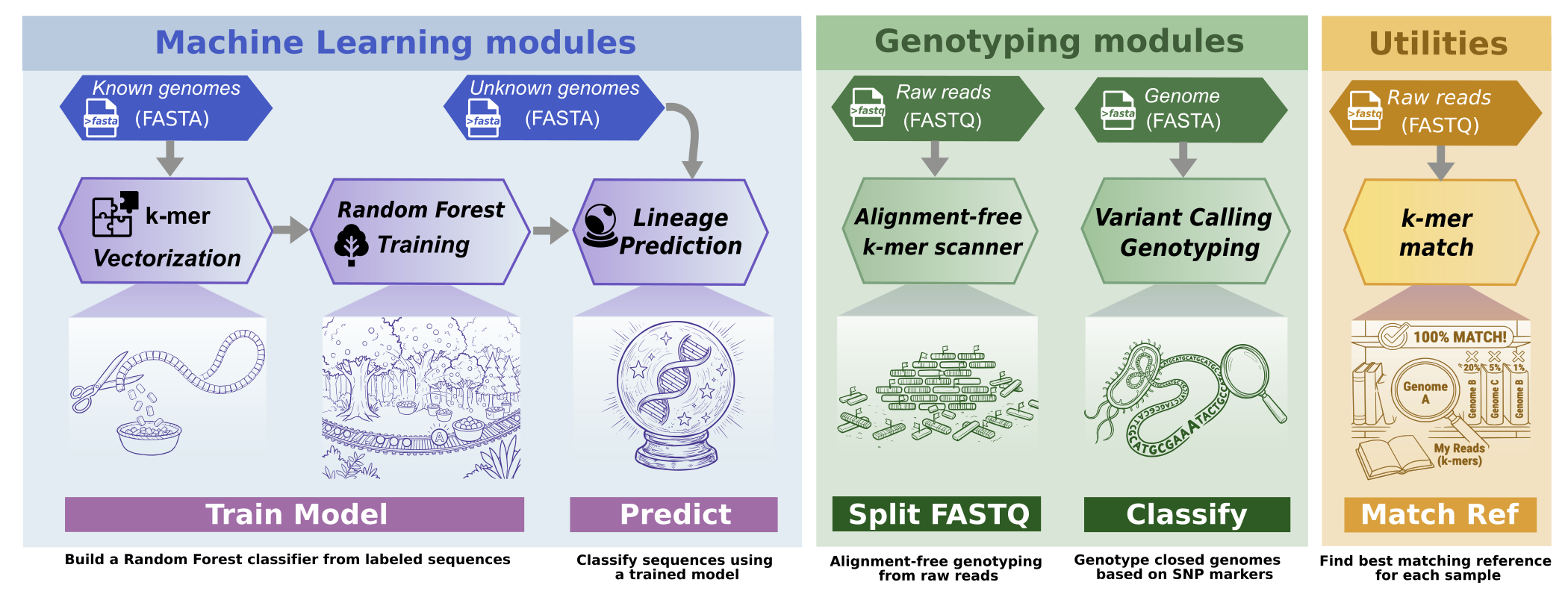
pathotypr is a Rust toolkit that classifies microbial genomes into lineages and genotypes them against user-defined marker panels. It works with both assembled genomes (FASTA) and raw sequencing reads (FASTQ), runs on a single laptop, and ships with a native desktop GUI.
Validated for M. tuberculosis only
Nothing is hard-coded to one organism, so any species works in principle. In practice pathotypr has only been validated on the MTBC: treat other organisms as exploratory and check them against a truth set you trust.
Five commands, one binary
| Command | What it does | Input |
|---|---|---|
train |
Build a Random Forest classifier from labeled genomes | FASTA |
predict |
Assign lineages using a trained model | FASTA + model |
classify |
Call known SNP markers in assemblies | FASTA + markers |
split-fastq |
Alignment-free genotyping from reads | FASTQ + markers |
match |
Find the closest reference genome | FASTQ + references |
Highlights
-
Organism-agnostic by design
Bring your own markers for any pathogen — nothing is hard-coded to a single organism. Validated on MTBC only; other species are untested.
-
Fast
Rust + SIMD gzip + parallel k-mers process a sample in roughly 1–2 seconds.
-
Desktop GUI
A native app built with Tauri — drag-and-drop files, no server required.
-
Excel + TSV output
Tabular results everywhere, with interactive visualizations in the GUI.
Quick start
Excel output
Add --excel to classify, predict, split-fastq or match to also generate .xlsx files alongside the TSVs (train writes its reports as TSV only).
Where to next
-
Pre-built desktop apps, Bioconda, or build the CLI/GUI from source.
-
Detailed usage, options, and output formats for each subcommand.
-
Specifications for training FASTA, marker TSVs, and input lists.
-
The design and data structures behind each module.
Citation
If you use pathotypr, please cite:
Ruiz-Rodriguez P, Coscollá M. Alignment-Free Tool for Assemblies and Reads in Genomic Surveillance of Tuberculosis. Emerg Infect Dis. 2026;32(11):1913-1918. doi: 10.3201/eid3211.261074
See Citation for BibTeX and RIS entries, the software and marker DOI, and the licence.