Command Line Tutorial
The command line is get_MNV's main interface: everything the tool can do is reachable from it, and it is what you put in a pipeline. This tutorial runs it end to end on the bundled M. tuberculosis example, and spends most of its time on the part that matters, reading what comes back.
There is a Desktop GUI Tutorial covering the same ground in the app.
1. Get the example data
The example/
folder of the repository ships everything you need:
| File | Role |
|---|---|
MTB_ancestor.fas |
Reference (single contig MTB_anc) |
anot_genes.txt |
Gene table (name, start, end, strand) |
G35894.var.snp.vcf |
VarScan-style variant calls |
G35894.demo.bam |
Tiny aligned-read subset for read support |
git clone https://github.com/PathoGenOmics-Lab/get_MNV.git
cd get_MNV/example
2. Annotate the variants
get_mnv \
  --vcf G35894.var.snp.vcf \
  --fasta MTB_ancestor.fas \
  --genes anot_genes.txt
get_MNV logs what it decided before it logs what it found. The run prints its whole configuration, then the lines that matter:
[INFO get_mnv::pipeline] Using genetic code: Bacterial/Archaeal/Plant Plastid (NCBI table 11)
[INFO get_mnv::io::annotation::tsv] TSV gene entries parsed: 4008 | mapped to SNPs: 635 | without SNPs: 3373
[INFO get_mnv::pipeline::processing] Contig 'MTB_anc' -> 950 SNP/variant records in VCF, 635 mapped genes
[INFO get_mnv::pipeline::processing] Contig 'MTB_anc' -> 134 intergenic variant(s) added
[INFO get_mnv::pipeline] Summary 'MTB_anc' -> variants=941 (SNP=797, MNV=0, SNP/MNV=10, INDEL=0, intergenic=134)
[INFO get_mnv::pipeline] Processing complete. Output files generated successfully.
It writes G35894.var.snp.MNV.tsv in the current directory.
Read the summary line, every time
950 records became 941 variants because a codon carrying two
substitutions is reported once. SNP/MNV=10 is the codon-level work: ten
codons where separate VCF records combine. MNV=0 means no single record
already carried more than one substituted base.
intergenic=134 is your sanity check on the annotation. get_MNV cannot tell
a variant outside a gene from a variant whose gene it failed to find, so a
mismatched annotation does not fail: it succeeds, reports almost everything
as intergenic, and prints Processing complete. If that count is most of
your variants, your gene coordinates do not line up with your reference.
Genetic code
get_MNV defaults to NCBI translation table 11 (bacterial), which is correct
for M. tuberculosis. Use --translation-table for other organisms.
Use --dry-run to get the same summary with nothing written, which is the cheap
way to check inputs before a long run.
3. Read the output
Open the TSV. One row stands out: gene Rv2036 carries two SNVs in the same
codon.
| Column | Value |
|---|---|
Positions |
2282376, 2282377 |
Reference Bases / Base Changes |
T, T → C, C |
Reference Codon |
GTT |
SNP Codon |
GCT, GTC |
MNV Codon |
GCC |
AA Changes |
Val93Ala |
SNP AA Changes |
Val93Ala, Val93Val |
Variant Type |
SNP/MNV |
SO Term / Impact |
missense_variant / MODERATE |
HGVS g. |
g.[2282376T>C;2282377T>C] |
Read one base at a time, the two substitutions disagree: GCT is Val93Ala and
GTC is Val93Val, a silent change. Read together as GCC, the codon is a
single Val→Ala substitution. That reclassification is what get_MNV is for, and
it is invisible to a per-SNV annotator. See
Output Formats for every column.
4. Add read support
Annotation says what the codon would mean. It does not say whether any single molecule carries both changes. For that, give get_MNV the alignments:
get_mnv \
  --vcf G35894.var.snp.vcf \
  --fasta MTB_ancestor.fas \
  --genes anot_genes.txt \
  --bam G35894.demo.bam
The Rv2036 row gains its evidence columns:
| Column | Value | Meaning |
|---|---|---|
MNV Reads |
24 |
reads carrying the whole haplotype |
MNV Forward Reads |
12 |
balanced across strands |
MNV Reverse Reads |
12 |
the other half of the same balance |
Total Reads |
24 |
depth at the codon |
MNV Frequencies |
1.0000 |
every read spanning it carries both |
SNP Reads |
0, 0 |
reads carrying one change without the other |
MNV Phasing Support |
1.0000 |
of the reads that could answer, all carried both |
MNV Phasing Reads |
24 |
how many reads answered |
Haplotype LD |
- |
see below |
SNP Reads = 0, 0 next to MNV Reads = 24 is not a gap: the two columns split
the evidence instead of double-counting it. No read carries one substitution
alone, so nothing lands in the solo counts.
Why Haplotype LD is empty on a perfect haplotype
D' measures whether two variants co-occur more than their own frequencies
predict. Here both are on all 24 molecules, so neither varies and there is
nothing left to correlate: the honest answer is -, not 1. That is a
different question from MNV Phasing Support, which asks how many of the
reads that could answer carried the whole haplotype, and answers 1.0000.
Linkage works through the cases where they diverge.
BAM requirements
The BAM must be coordinate-sorted and indexed (.bai), and aligned to the
same reference. The bundled G35894.demo.bam covers only the Rv2036
locus, which is why every other row reports no read support.
5. Filter on that support
With a BAM you can require evidence. The thing to know before you do is how the two thresholds combine on a codon-level row:
| Command | Rows | What happened |
|---|---|---|
| (no filter) | 941 | everything |
--snp 1 |
10 | every plain SNP row without a supporting read is gone; the 10 codon-level rows stay |
--mnv 5 |
941 | nothing happens |
--snp 1 --mnv 5 |
1 | only Rv2036, the one codon with reads |
A SNP/MNV row is kept when either its individual SNVs clear --snp or
its haplotype clears --mnv. That is deliberate, so a well-supported haplotype
survives even when its individual SNVs do not. The consequence is easy to trip
over: with --snp left at its default of 0, the SNP side passes trivially,
so --mnv on its own never removes a row. Raise both, or neither.
6. Get a report you can send
The same run writes a single self-contained HTML file:
get_mnv \
  --vcf G35894.var.snp.vcf \
  --fasta MTB_ancestor.fas \
  --genes anot_genes.txt \
  --bam G35894.demo.bam \
  --report sample.html
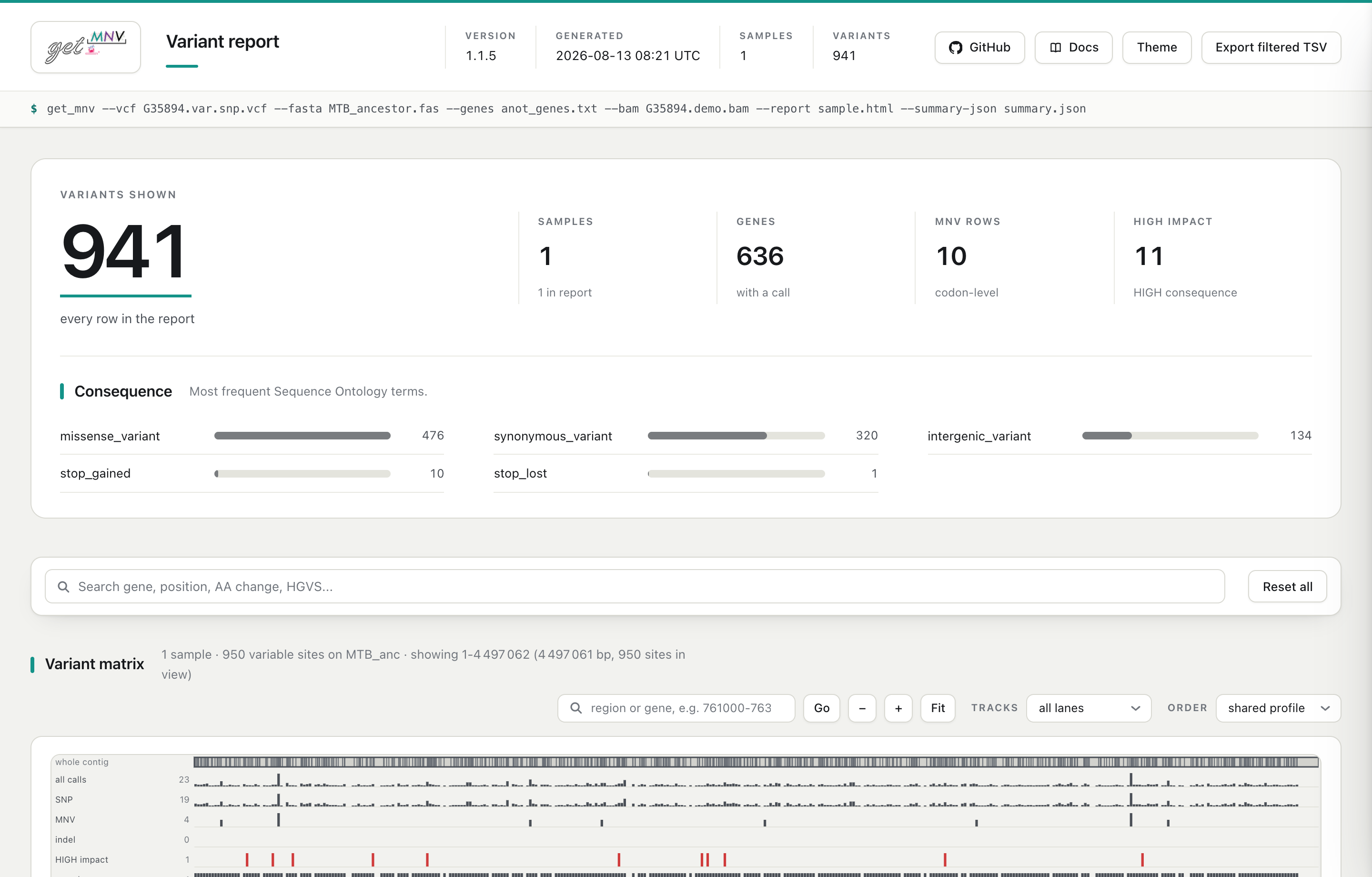
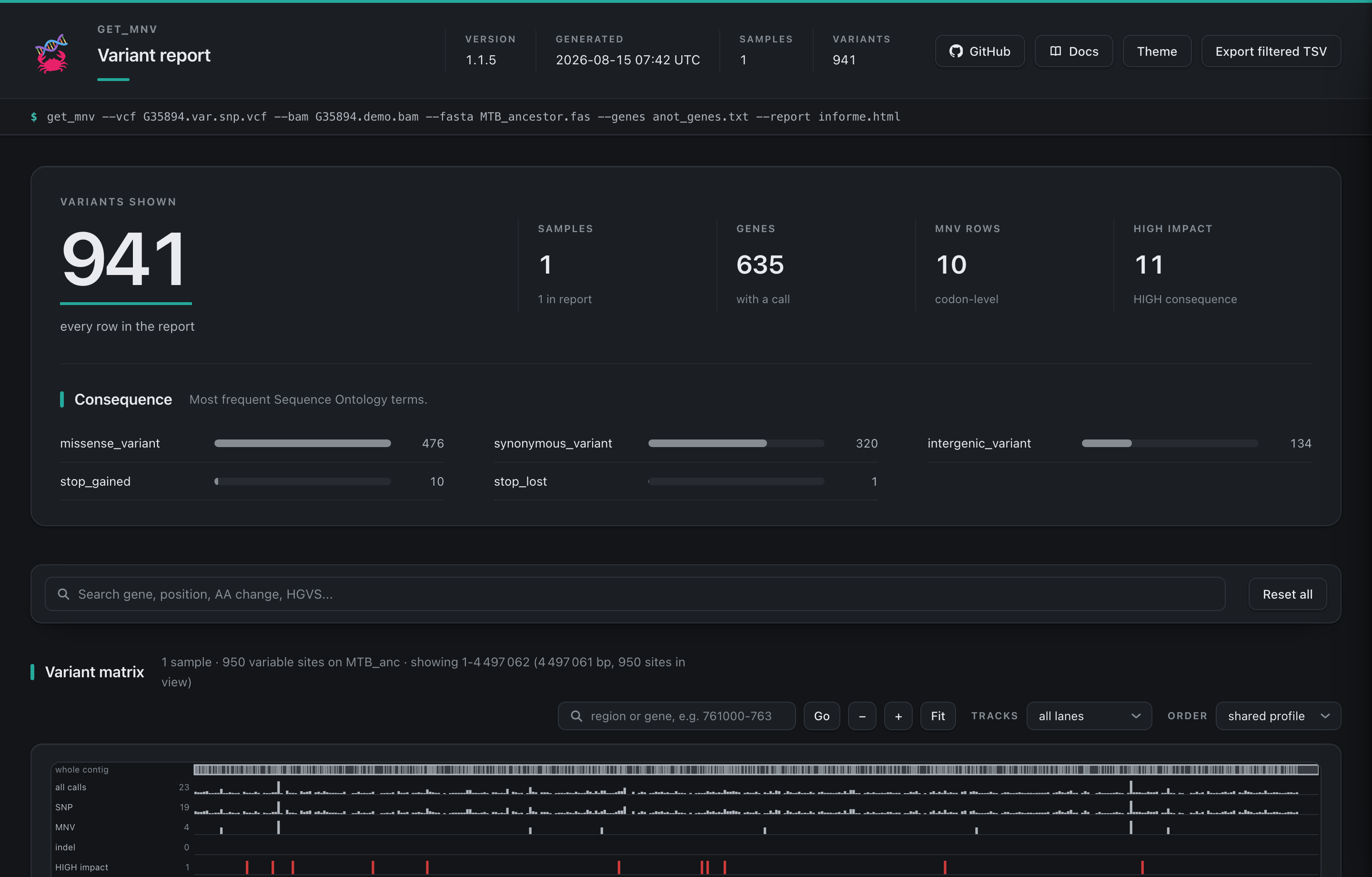
The report opens in any browser with no server and travels as one attachment. It records the exact command that produced it along the top.
It is searchable and filterable, breaks the calls down by Sequence Ontology term
(here 476 missense, 320 synonymous, 134 intergenic, 10 stop gained, 1 stop
lost), and draws a variant matrix across the contig. For a cohort already
processed one sample per run, build one report from the existing outputs with
--report-from run1.MNV.tsv run2.MNV.tsv --report cohort.html.
7. The other things it can write
| Flag | Output |
|---|---|
--convert / --both |
VCF instead of, or alongside, the TSV |
--vcf-gz / --index-vcf-gz |
BGZF-compressed VCF and its Tabix index |
--bcf |
BCF converted from the generated VCF |
--summary-json <FILE> |
the summary above, machine-readable |
--run-manifest <FILE> |
command, version, inputs, outputs and checksums |
--error-json <FILE> |
structured error details when a run fails |
Next steps
- Common Recipes: ready-to-run commands for the usual jobs.
- CLI Reference: every option, with its default.
- Input Formats and Output Formats.
- Scope and Compatibility: boundary rules and tuning.
- Linkage: telling a real haplotype from a coincidence.
- Desktop GUI Tutorial: the same run in the app.